
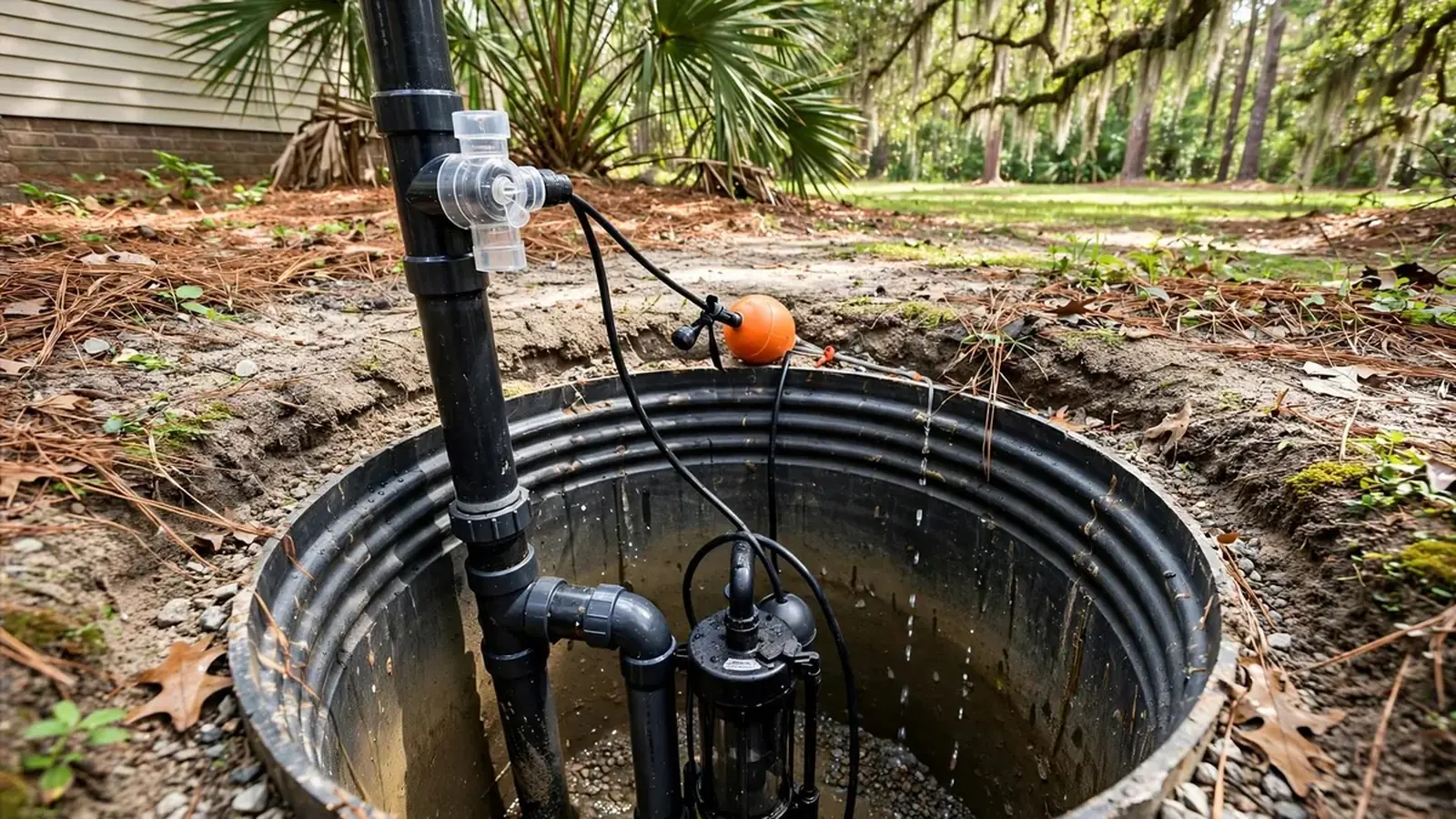
Five checks before you call a plumber
Work through these in order. Unplug the pump before you touch anything in the pit, and do not reach in while the floor is wet around an outlet.
- Power: check that the pump is plugged into a working outlet and that the breaker has not tripped. A pump on a GFCI outlet can trip it when the pit is wet.
- Float: lift the float switch by hand. If the pump starts, the float was jammed against the pit wall or a pipe.
- Intake: if the pump runs but moves little water, silt or gravel may block the intake screen under the pump.
- Discharge: follow the pipe outside. Ice, a kinked hose or a clogged end can stop the flow.
- Check valve: if the pump cycles every few minutes, the valve above it may be letting water fall back into the pit.
What each symptom usually means
| Symptom | Likely cause | Who fixes it |
|---|---|---|
| Pump will not start | No power or stuck float | You can often fix it |
| Hums but pumps nothing | Jammed impeller or blocked intake | A plumber, safely |
| Runs constantly | Float stuck on or check valve failed | You can check the float, then call |
| Cycles every few minutes | Check valve leaking back | A plumber replaces the valve |
| Loud grinding | Worn bearings or debris | Replace the pump |
When repair stops making sense
A pump that has lasted many years and now needs a new float, a new check valve and a clean-out is close to the end. A new pump costs more than those parts but removes the next failure. If you also have no backup power, replacing the pump is the moment to add one.
A plumber can size the new pump to the pit, set it on a firm base and test the float with water. That visit usually takes a couple of hours.
A five-minute pump test before storm season
Pour in water
Add several buckets to the pit until the float rises.
Watch the cycle
The pump should start, empty the pit and shut off cleanly.
Check the outlet
Walk outside and confirm water flows away from the house.
Test the backup
If you have a battery backup, unplug the main pump and test it too.
Local note: how Revere handles flood risk and what you can use
According to the City of Revere flood-readiness page, Hohonu flood sensors sit at Mills Avenue, Rumney Marsh, Belle Isle Marsh and Pearl Avenue, with High Water and King Tide text alerts. If you live near those places, sign up for alerts and test the pump when one arrives.
The same page lists recent drainage work, including Library Street drainage improvements and Martin Street tide gate improvements, and says the Water and Sewer Department, DPW and Engineering Division clean catch basins and sweep streets. A clogged street catch basin near you can be reported through Revere 311 at 781-286-8311.
The city also recommends sump pumps and backflow preventers for basements. A pump handles groundwater, while a backflow preventer on the sewer line stops street water entering through floor drains.
Sources: City of Revere flood-readiness and Water and Sewer Department pages (municipal source).
Pump dead and rain coming?
Call the 24/7 line. A licensed plumber can come the same day when available.
Keep the discharge out of the sewer
Revere's Water and Sewer Department says connecting downspouts, foundation drains or other surface or groundwater sources to the sewer service is prohibited. If your pump drains into a floor drain, fix it when you repair the pump.
The discharge pipe should end outside, far enough from the foundation that water does not run back. A basement waterproofing plan can add interior drains that feed the same pit. Chelsea homeowners with the same problem can use our Chelsea emergency plumber page.
Backup power and alarms for a storm night
Most pump failures happen when the weather is worst. Storms cut power, and a pump with no backup stops when the grid does. A battery backup pump sits beside the main pump and takes over when power fails or the main pump cannot keep up.
A water alarm is cheap and loud. Set it a few inches above the pump so it sounds before the pit overflows. Test the alarm and the backup battery when you test the pump, and replace the battery when the maker says to.
Common questions
Can a homeowner replace a sump pump?
Often yes for a like-for-like swap, if you can safely reach the pit and shut off power. A plumber is the better choice when the pit, check valve or discharge also needs work.
How do I know my sump pump is failing?
Loud grinding, constant running, short cycling or a pit that fills while the pump sits idle all point to failure. Test it before wet weather.
Does a battery backup help in a storm?
Yes. Storms often cut power, and a backup runs the pump for a limited time. Test the battery regularly.
Does Revere offer flood alerts for homeowners?
Yes. The city lists High Water and King Tide text alerts connected to its Hohonu sensors. Check the city flood-readiness page to sign up.
Is a sump pump the same as a backflow preventer?
No. A sump pump removes groundwater from a pit. A backflow preventer stops sewage or street water coming back through your drains.