
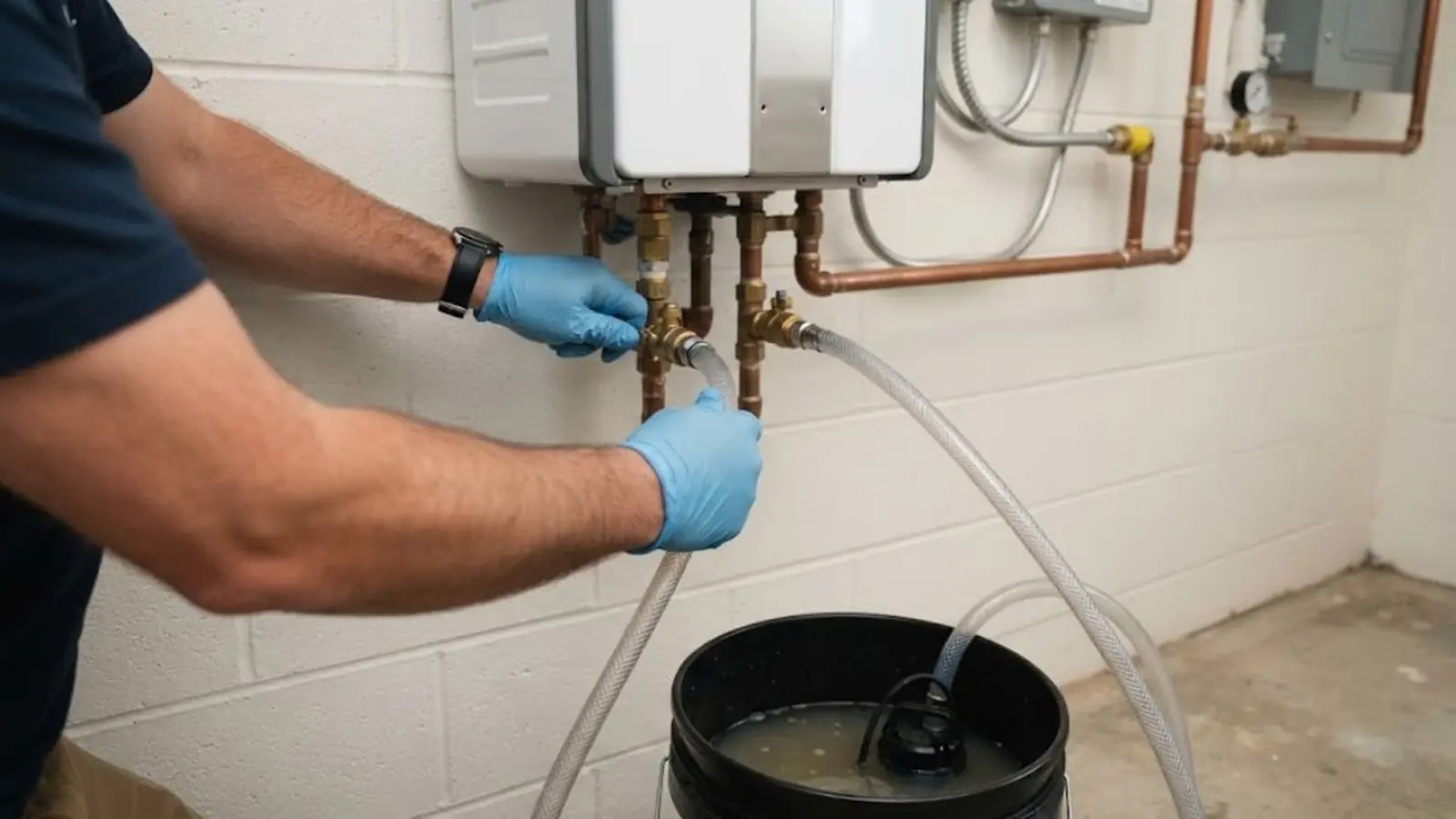
What scale does to a tankless heater
A tankless heat exchanger has thin passages. Minerals in the water coat those passages over time and cut the flow of heat. The first signs are lukewarm water at high flow, longer waits for hot water and error codes about temperature or flow.
A flush dissolves that coating. It does not fix a bad igniter or a gas supply problem, so a plumber reads the unit's history first if the heater has been misbehaving.
What you need
Isolation valves
Service ports on the hot and cold lines. If your heater lacks them, a plumber adds them first.
A small pump and hoses
A circulation pump with two hoses and a bucket.
Descaling solution
Use what your manual specifies. Many accept white vinegar, others require a branded solution.
The manual
It lists the time, volume and any steps unique to your model.
The flush, step by step
Always turn off power or gas and let the unit cool before starting.
Isolate
Turn off the gas or power. Close the hot and cold isolation valves and open the service ports.
Connect
Attach hoses and the pump to the ports and pour the solution into the bucket.
Circulate
Run the pump for the time your manual states. Many makers suggest about an hour.
Rinse and restore
Drain the solution, flush with clean water, clean the inlet screen, open the valves and restart the unit.
Local note: how often Revere homes should flush
According to the MWRA, which supplies Revere, its water is soft at about 16 mg/L of hardness, which the MWRA states is roughly 1 grain per gallon. The MWRA also says you do not need a water softener.
Soft water builds scale slowly. A flush every one to two years may be enough in a Revere home, but follow your heater's manual. The treated water has a pH of about 9.0 to 9.5, which the MWRA adjusts to reduce lead and copper leaching, so it is not aggressive on the heat exchanger.
The more likely problem in Revere is debris. Water main work can loosen sediment, and a clogged inlet screen cuts flow. Clean the screen each time you service the unit.
Sources: MWRA drinking water hardness page (utility source).
How often to flush by situation
| Situation | Suggested check | Why |
|---|---|---|
| Revere home, typical use | Every 1 to 2 years | Soft water, slow scaling |
| Heavy use, large family | Every year | More heating cycles |
| Error code for flow or heat | Now | May be scale or a clogged screen |
| No service valves installed | Add valves first | You need ports to flush |
Prefer a plumber to do it?
Call to book a flush and a safety check.
When not to do it yourself
Do not flush a gas unit if you smell gas, see scorch marks or have never used the unit. Leave the building and call 911 or National Grid at 1-800-233-5325. If you rent, ask the landlord first.
A plumber can also check the venting and gas pressure while the unit is open. For a failing unit, see water heater repair, and for a replacement see installation. Neighbors in Chelsea can use our Chelsea page.
What to do before you open the unit
Read the manual page on descaling first. Confirm the unit has service valves, that you have the right solution and that the room is ventilated if you use vinegar. Put a towel and a bucket under the ports.
Write the date of each flush on a label near the unit. A simple log tells the next plumber what was done and how the unit behaved afterward.
If the unit shows an error code when you restart it, stop. Note the code and call a plumber rather than resetting it repeatedly.
Problems a flush will not fix
A flush clears scale and fine debris. It does not repair a failed igniter, a bad flame sensor, a cracked heat exchanger or a gas supply that is too small. If hot water is still weak after a flush, the cause is somewhere else.
Cold water sandwiches, where hot water turns cold for a few seconds, usually come from low flow or short bursts of use. Fixtures with very low flow may not trigger the unit at all. A plumber can test the minimum flow and check the settings.
Take photos of the error code and the settings before you call. They help the plumber arrive with the right parts.
Common questions
Can I use vinegar to flush a tankless heater?
Many manuals allow white vinegar, but some require a specific solution. Follow the manual for your model.
How long does a flush take?
About an hour of circulating plus setup and rinse. Allow two hours.
Do I need a flush if the heater works fine?
In soft-water Revere, you may be able to wait a year or two. Check the screen and look at the unit's error history.
Is Revere water hard enough to need a softener?
No. The MWRA calls its water soft, at about 1 grain per gallon, and says you do not need a softener.
What if I have no isolation valves?
A plumber can install them. Without them, flushing is hard and risky.